
Table of Contents
- What Separates Durable Tech Accessories From Disposable Ones
- How to Organize Tech Accessories for Travel
- Durable Charging Cables for Travel
- Essential Travel Tech for One-Bag Travelers
- Power Gear That Holds Up: Stations, Inverters, and Chargers
- Packing and Carrying Durable Tech Accessories
- Frequently Asked Questions
Last Updated: September 13, 2026
What Separates Durable Tech Accessories From Disposable Ones
Durable tech accessories for frequent travelers are built around replaceable wear points, honest material specs, and warranty terms that actually cover travel use. The difference shows up after the tenth trip, not the first. This guide from Loop Te Loop breaks down what to check before you buy.

The global travel accessories market is projected to reach a substantial valuation in 2026, growing at a steady compound annual rate, according to Business Research Insights market forecast. Long-term projections from Fortune Business Insights travel accessories outlook point the same direction: more people are buying gear meant to survive repeated trips rather than a single season.
Here's the contrarian part. Most "durable" claims on product pages describe the shell, not the failure point. Cables fail at the strain relief. Power banks fail at the port. Backpacks fail at the zipper pull and the strap anchor. A thick outer material tells you almost nothing about whether the accessory survives a year of airport security trays.
Materials and Construction That Survive Repeated Packing
Braided nylon over-molding, reinforced strain relief, and metal rather than plastic connector housings are the three construction details that separate gear that lasts from gear that doesn't. Field testing of travel tech accessories has identified specific components that endure a decade of frequent use versus those prone to early failure, according to long-term travel gear field testing.
What most guides miss is that flexibility matters as much as strength. A cable that resists bending eventually cracks at the bend point. A cable engineered to flex distributes stress along its length.
Warranty, Certification, and Replacement Signals
A warranty that excludes "normal wear" is not a warranty, it's marketing. Look for stated cycle ratings on batteries, certification marks on power electronics, and replacement parts sold separately. If the manufacturer sells a replacement strap or cable end, they expect the product to outlast the first failure.
How to Organize Tech Accessories for Travel
Organizing tech accessories for travel comes down to one rule: every item has a fixed home, and that home is visible without unpacking. Dedicated tech pouches have become standard gear for digital nomads for exactly this reason, according to Pack Hacker gear reviews.
Pouches, Cable Ties, and Labeling Systems
A workable system needs three things and nothing more:
- One pouch for power: chargers, adapters, power bank, cable ties
- One pouch for data: cables, dongles, memory cards
- One flat sleeve for the laptop: separate from everything else
Label the pouches, not the cables. Labels on cables wear off within months. Color-coded cable ties survive years and let you grab the right cable without reading anything.
| Item | Storage Method | Why It Works |
|---|---|---|
| Charging cables | Velcro tie, one per cable | Prevents tangling and strain |
| Power bank | Padded pouch pocket | Absorbs impact in transit |
| Adapters | Small zip pouch | Keeps small parts findable |
| Laptop | Flat sleeve, separate bag | Reduces flex stress on hinges |
Durable Charging Cables for Travel
The most durable charging cables for travel use braided jackets, reinforced strain relief at both ends, and connectors rated for thousands of insert cycles. Cable failure is almost always mechanical, not electrical.
Three habits extend cable life more than any product choice:
- Coil cables loosely, never wrap them around your hand
- Unplug by the connector housing, never by the cord
- Keep one backup cable per device type in your pouch
The thing nobody tells you about braided cables is that the braid protects the jacket, not the internal conductors. If the strain relief is thin, the wires inside still break at the same point a cheap cable would.
Essential Travel Tech for One-Bag Travelers
Essential travel tech for one-bag travelers means multi-purpose items that replace two or three single-use gadgets. A 3-in-1 certified magnetic wireless charger, for example, replaces three separate charging bricks and their cables with one stand, and Loop Te Loop carries it at $66.90.
[The Water-Resistant 17/20-Inch Travel Laptop Backpack](https://loop-te-loop.myshopify.com/products/2026-waterproof-17-20-inch-laptop-backpack-men-airplane-travel-everyday-backpacks-women-oxford-rucksack-male-school-bag-mochila) at $530.66 fits the one-bag approach directly: a 36 to 55 liter capacity, water-resistant construction, and air-cushion shoulder straps for long transit days. It holds a 17-inch or 20-inch laptop, which means one bag covers work and clothing.

Not everyone agrees with this approach. Some travelers argue that carrying excessive tech accessories adds unnecessary weight and complexity, advocating for one-bag travel with only essential, multi-purpose items, according to minimalist packing perspective. That's a fair critique, and it's why multi-purpose gear beats specialty gear for this audience.
Power Gear That Holds Up: Stations, Inverters, and Chargers
Power gear holds up when the battery chemistry and cycle rating are stated, not implied. LiFePO4 batteries are the current standard for portable stations because they tolerate far more charge cycles than older lithium chemistries.
Loop Te Loop stocks two portable stations worth comparing:
| Product | Capacity | Best For | Price |
|---|---|---|---|
| 500W Portable Power Station | 461Wh LiFePO4 | Camping, RV, emergency backup | $599.11 |
| Jackery Explorer 500 v2 | 510Wh LiFePO4 | Home backup, longer trips | $1,820.13 |
The 500W Portable Power Station weighs under 10 kg and accepts solar input, which matters if you're working away from outlets for days. [The Jackery Explorer 500 v2](https://loop-te-loop.myshopify.com/products/jackery-portable-power-station-explorer-500-v2-new-with-5m-extension-cord-510wh-solar-generator-for-outdoors-camping-travel) adds a foldable handle, dual AC outlets, and a 5 m extension cord.

For vehicle-based travel, the 12V/24V Car Power Inverter with USB-C and QC 3.0 at $59.72 converts vehicle DC power to AC output. Confirm your vehicle voltage and connected device requirements before ordering.
Packing and Carrying Durable Tech Accessories
Packing durable tech accessories well is about load distribution, not compression. Heavy items go closest to your spine, cables go in the middle, and anything fragile stays away from the bag's exterior walls.
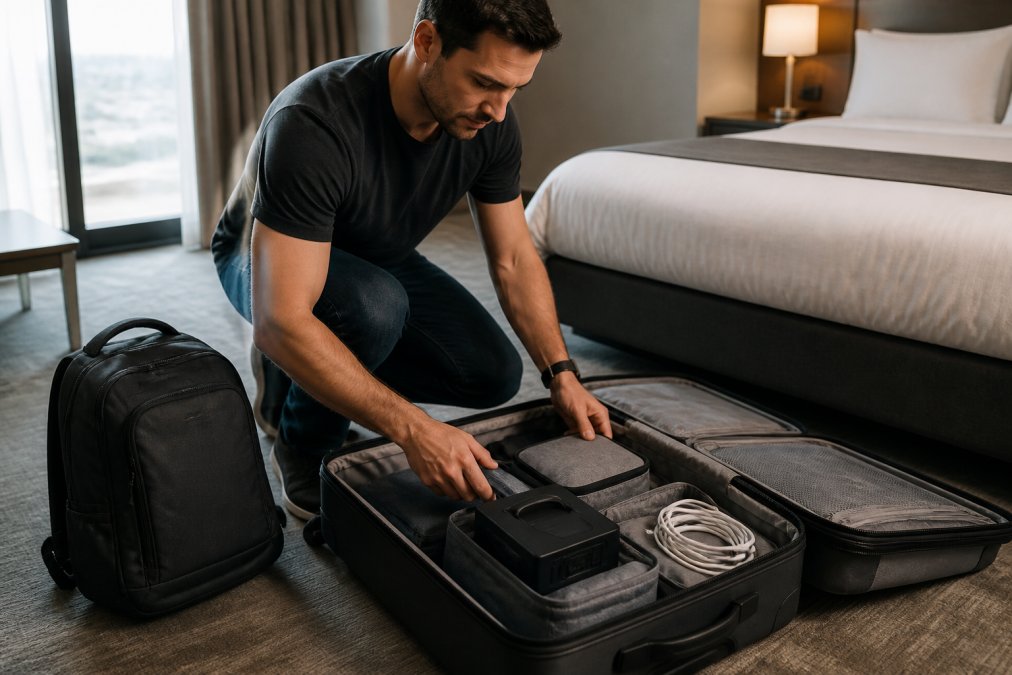
A few practical rules that hold up in practice:
- Put the power station at the bottom, against the bag's back panel
- Keep cables in a pouch, never loose in the main compartment
- Place the laptop sleeve against your back, not the outer wall
- Leave one empty pouch pocket for receipts and adapters you pick up mid-trip
[An Inflatable Footrest Pillow](https://loop-te-loop.myshopify.com/products/inflatable-footrest-pillow-pvc-foot-rest-air-pillow-cushion-for-travel-office-home-leg-up-relaxing-feet-tools-under-desk) at $97.18 deflates flat enough to slot beside a packed pouch, which matters when space is the constraint and comfort is the goal on long flights.
Frequently Asked Questions
What are the most durable tech accessories for long-term travel?
The accessories that survive repeated trips share a few traits: water-resistant shells, reinforced seams, and replaceable or standardized parts. A water-resistant 17/20-inch laptop backpack with air-cushion straps handles daily abuse, while a LiFePO4 power station rated for thousands of charge cycles outlasts cheaper lithium packs. Look for certified chargers and cables with braided jackets rather than thin molded plastic, which cracks first at the connector.
How do I organize tech accessories for travel without losing cables?
Use one pouch per category: charging, adapters, and audio. Keep cables coiled with hook-and-loop ties and label both ends with a small tag. A dedicated tech pouch keeps everything visible in one layer, so you can spot a missing cable before you leave the hotel. Pack the pouch at the top of your bag so you never dig through clothing to reach a charger at the airport.
Are expensive travel tech accessories worth the investment?
Price alone does not guarantee durability, but construction does. A 3-in-1 magnetic wireless charger at $66.90 with ABS, PC, and silicone housing resists the flexing and heat that break cheap stands. A 500W LiFePO4 power station at $599.11 costs more upfront yet is rated for far more cycles than entry-level lithium packs, which often fail within a couple of years of frequent use. Compare cycle ratings and materials, not just the sticker.
What tech gadgets are actually worth the space in a carry-on?
Prioritize items that replace two or three others. A 3-in-1 wireless charger consolidates phone, watch, and earbuds charging into one stand. A 12V/24V car power inverter with USB-C and QC 3.0 turns a rental car outlet into a workstation. For longer trips, a compact power station covers laptop and camera charging without hunting for wall outlets. Leave single-purpose gadgets at home unless you use them daily.
Buying gear that survives repeated trips is less about finding the toughest product and more about checking the parts that actually fail: strain relief, port construction, battery chemistry, and warranty terms that cover real use. Loop Te Loop curates tech accessories with those details in mind, from the water-resistant travel laptop backpack to the 3-in-1 magnetic wireless charger and the LiFePO4 power stations. Get started with Loop Te Loop and build a travel kit that outlasts the trip.


